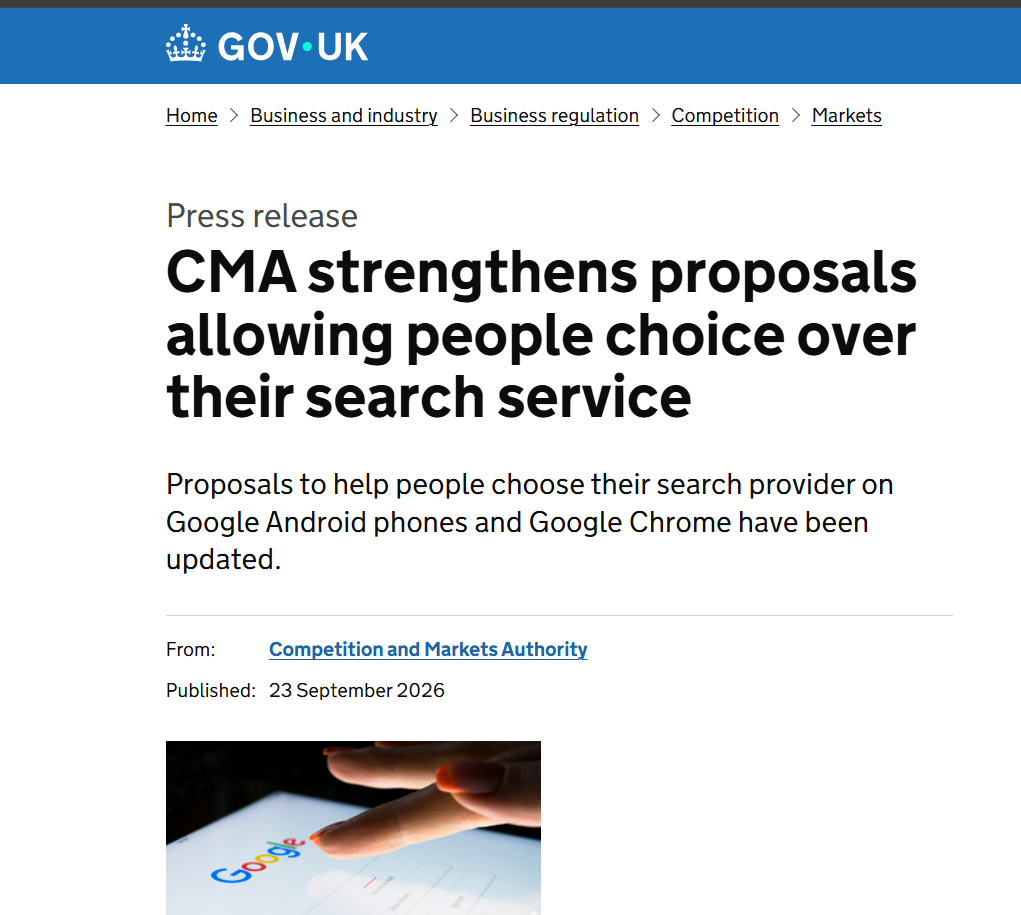
On 23 September 2026, the Competition and Markets Authority (CMA) published strengthened proposals on search choice. The plans would give millions of Android and Chrome users in the UK a choice of search service.
AI assistants that meet set criteria could appear on the screen alongside search engines. The CMA notes that AI assistants are not included on Google’s choice screens today.
Why now? The CMA says the way people search is changing, with growing use of services such as ChatGPT and Perplexity. It wants UK users to be able to pick the search service they prefer as new options arrive.
The consultation closed on 9 October 2026. The CMA expects to make its final decision by the end of the year.
For business owners, this is more than a regulatory story. It concerns the first step of many customer journeys: the search box.
If you run or lead a business, you are probably asking:
- What exactly is the CMA’s search choice screen?
- Who would see it, and when?
- Could AI assistants such as ChatGPT appear on it?
- What could it mean for how customers find my business?
- What should I do before the final decision?
We will answer each question in turn. We will also show how your business can stay visible, whatever the CMA decides.
What Is the CMA’s Search Choice Screen?
The CMA’s search choice screen is a proposed screen that lets UK users pick their default search service. It would appear on Android devices and in Google Chrome.
A default search service is the one that answers when someone types into the address bar or home-screen search box. The CMA calls the way such choices are presented “choice architecture”. In plain terms, it is the design of a screen that shapes what people pick.
The proposal is a “conduct requirement”. That is a legal rule the CMA can place on a firm with strategic market status (SMS). SMS means the CMA has found substantial and entrenched market power in a digital activity.
The CMA designated Google with SMS in general search and search advertising on 10 October 2025. The CMA states that this designation is not a finding of wrongdoing.
The choice screen could change which service answers your customer’s first question.
To understand the potential impact of the CMA’s search choice screen, let’s first look at the key figures behind the proposals.
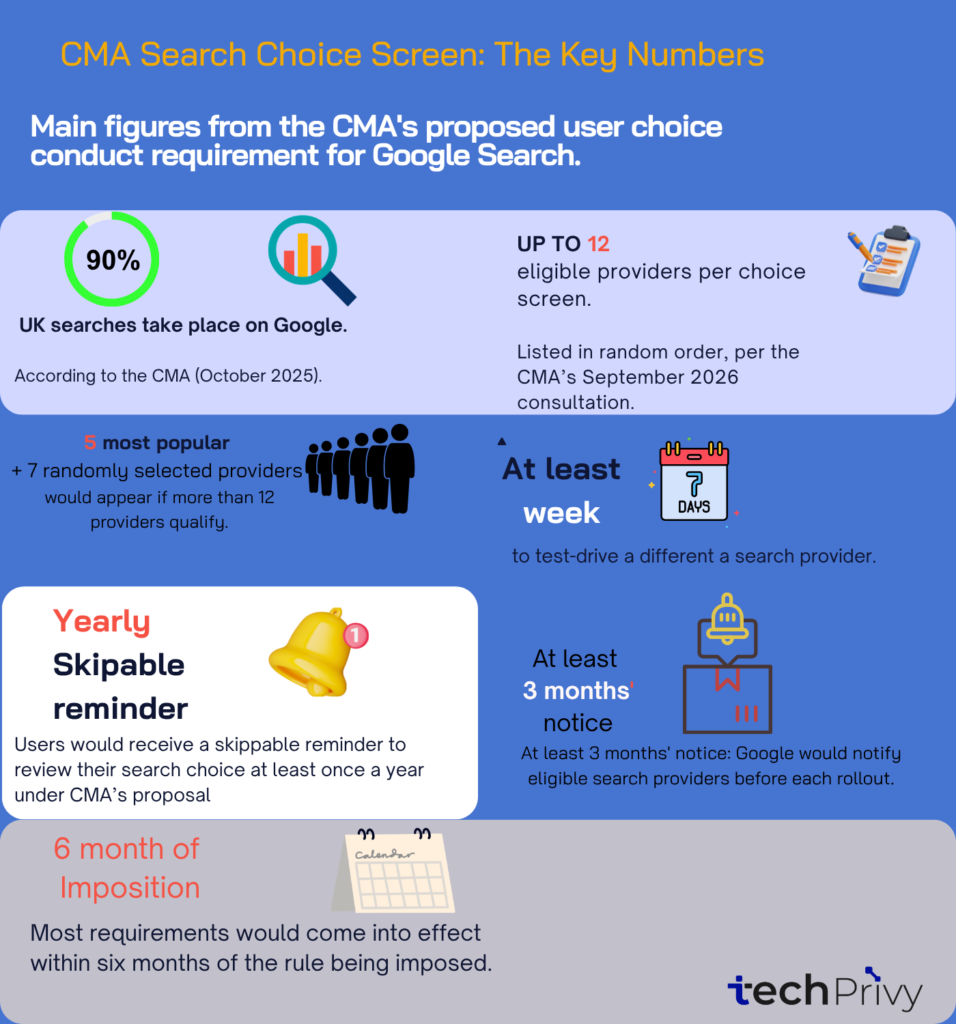
Before looking at how the screen would work, it helps to see the key numbers behind it.
Key Stats: The Search Choice Proposals in Numbers
Every figure below comes from the CMA’s own announcements or consultation documents.
- More than 90% of searches in the UK take place on Google, according to the CMA in October 2025.
- Each choice screen would list up to 12 eligible providers in random order, per the CMA’s September consultation.
- If over 12 qualify, the CMA expects the five most popular plus seven at random, per the consultation.
- A “test-drive” of a new provider should last no less than one week, the CMA says.
- Users on covered devices would see a skippable reminder at least once a year, under the CMA proposals.
- Google would give eligible providers at least three months’ notice before each rollout, according to the CMA consultation.
- Most of the requirement would come into force within six months of being imposed, the CMA proposes.
- In January 2026, the CMA estimated 40 to 50 million Android choice screens a year under its proposals. It estimated a further 15 to 35 million on Chrome for desktop and iOS, as restated in its September consultation.
- Three of four proposed conduct requirements for Google search were imposed in June 2026, according to the CMA. The choice screen is the fourth.
How Did We Get Here? The CMA and Google Search Since 2025
The choice screen is the final piece of a wider package of rules for Google search. Each rule affects how businesses are found online.
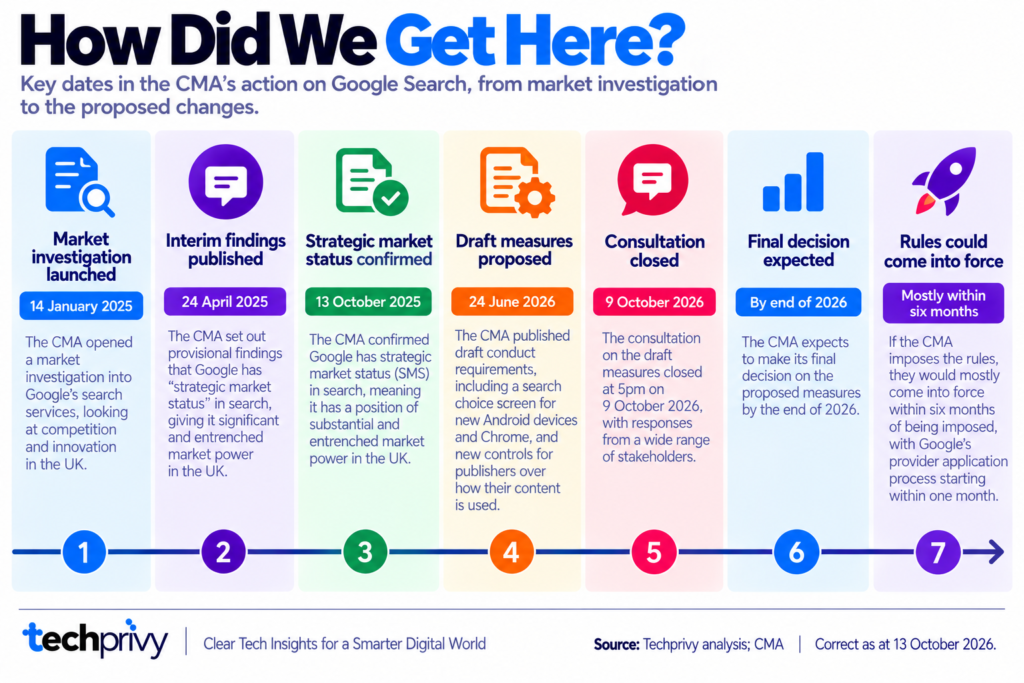
The UK’s digital markets competition regime came into force on 1 January 2025. The CMA opened its investigation into Google’s search services on 14 January 2025.
It confirmed Google’s SMS designation on 10 October 2025. The CMA said AI-based search features, such as AI Overviews and AI Mode, fall within that designation. It said Google’s Gemini AI assistant was not in scope, but that it would keep this under review.
If AI Overviews are new to you, our guide What Are AI Overviews and What Do They Mean for SEO? explains how they work.
In January 2026, the CMA consulted on four conduct requirements. Three are now in place.
1. Publisher controls (imposed 3 June 2026)
Under the publisher conduct requirement, publishers can stop their content powering Google’s AI search features, such as AI Overviews. Google must also attribute publisher content with clear links in AI-generated results. Publishers can also opt out of their content being used to fine-tune AI models. Google has nine months to implement the changes.
2. Fair ranking (imposed 17 June 2026)
Under the fair ranking requirement, Google must rank organic results using objective and non-discriminatory criteria. This includes AI Overviews, but not sponsored results.
Google must also give advance notice of significant ranking changes. It must offer clear processes for businesses to raise concerns. Google has six months to implement this requirement.
3. Data portability (imposed 17 June 2026)
Users can move their Google search data to authorised third parties, such as rewards platforms. This puts Google’s existing voluntary tool on a legal footing in the UK. Google has three months to implement it.
4. User choice (proposed, decision expected by end of 2026)
This is the search choice screen. The CMA first proposed it in January 2026, then strengthened the proposals in September.
The CMA has also designated Apple and Google with SMS for their mobile platforms. That work is separate from the search rules covered here.
Three of the four rules for Google search are already in place. The choice screen is the last one still open.
So what would the choice screen actually look like for your customers?
How Would the Search Choice Screen Work?
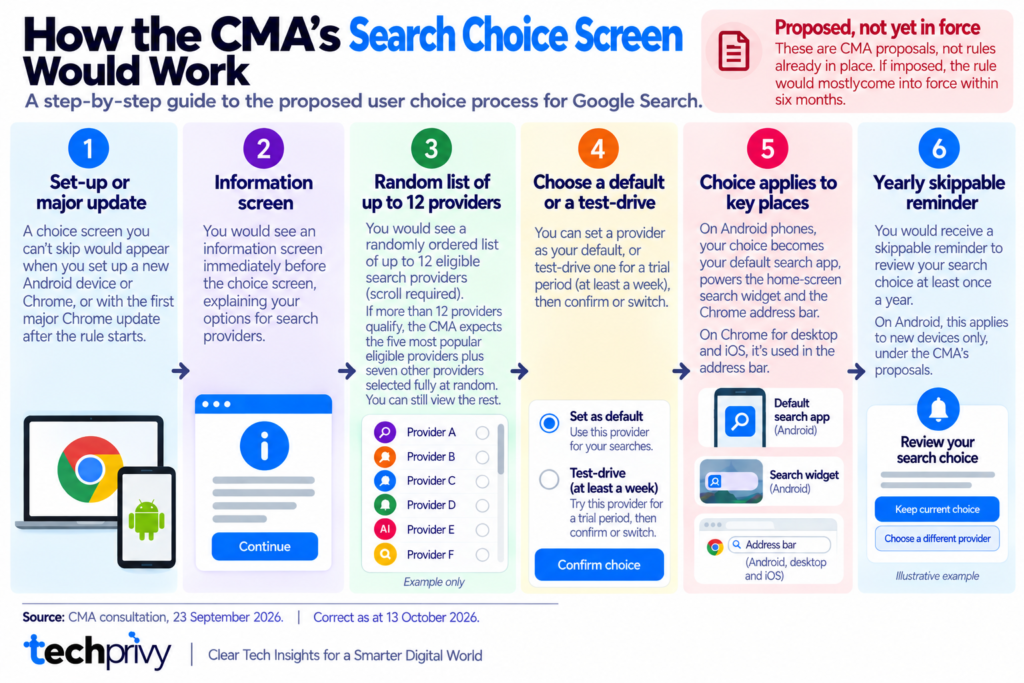
Under the September proposals, Google would show the screen at several moments:
- New Android devices: a screen that cannot be skipped, shown at first use or set-up.
- Chrome on desktop and iOS: a screen that cannot be skipped, shown with the first major Chrome update under the rule.
- New Chrome installs: a screen that cannot be skipped, shown at first use or set-up.
- Every year after: a skippable, small reminder linked to a major update. Google need not show it if the user changed their default in the last six months.
Before the list, users would see an information screen explaining the choice. Providers would then appear in a fully random order. Users would need to scroll through the full list before confirming.
A “test-drive” option would let people try a provider for a short trial period. The CMA says this should be no shorter than a week.
On Android, the choice would apply to the search app, home-screen widget and Chrome address bar. On Chrome for desktop and iOS, it would apply to the address bar. Android would also gain a single setting for changing the default.
Eligible providers would get tools too. They could check whether they are a user’s default and take the user straight to the relevant setting.
What I am trying to say is that this would not be a one-off choice. People on covered devices would be invited to think again, at least once a year.
Which Services Could Appear on the Screen?
Not every app could appear. The CMA proposes three eligibility criteria. A service would need to:
- Adequately handle the full range of general search uses, on a wide range of subjects, including by searching the web.
- Provide a functioning search experience on the relevant access points, such as the address bar.
- Be considered a general search service by a significant proportion of its UK users.
The CMA lists four types of search use. These are finding a website, finding something to buy, simple facts or news, and complex open-ended questions.
The second use matters for any business that sells online. A qualifying service would need to help people find products and services.
Any AI summaries must also credit web content clearly and accurately. Users must have a clear way to reach that content.
The CMA says a “significant proportion” of users means a meaningful share, not a majority. Google would run the approval process every six months. It would report its decisions to the CMA, with reasons for any rejection.
If AI assistants qualify, the question “Where do my customers search?” gets several new answers.
Why Are AI Assistants Now Part of the Picture?
The CMA says the line between AI assistants and traditional search is increasingly blurred. Many search services already include AI summaries and AI interfaces. So the CMA does not think an AI component should exclude a service.
The CMA’s own user research found that many people see AI services as different from search engines. Yet they increasingly use them for search. When people noticed AI services on a test choice screen, they engaged more with the full list.
Views were mixed. Several consultation respondents opposed including AI services. Two argued that AI services may not handle key search uses, such as finding a specific website.
Four others pointed to the CMA’s decision to leave Gemini out of Google’s designation. The CMA replied that this decision concerned Google’s products, not the whole sector.
Respondents to the earlier consultation included OpenAI, Microsoft, DuckDuckGo, Mozilla, Samsung, Which? and Trainline. That range shows how many organisations have a stake in the outcome.
Which services finally qualify will depend on Google’s assessment against the criteria, overseen by the CMA. For businesses, the list of platforms worth watching may widen. It could include Microsoft Bing and Copilot, OpenAI’s ChatGPT and Perplexity, alongside Google.
How Has Google Responded?
Google’s views are set out in the CMA’s consultation document. Google agreed with the original eligibility criteria. It also supported extending the screen to Chrome on desktop and iOS, and to its Pixel phones.
Google proposed its own “UK Choice Package”. This included a central search switch on Android, a longer list of providers and an information screen.
Google raised concerns that yearly screens and test-drives could interrupt users. It also said some changes would be technically complex on existing Android devices, which depend on phone makers.
The CMA made changes in response. The yearly reminder became skippable and smaller. Yearly reminders and test-drives would now apply to new Android devices, plus Chrome on desktop and iOS.
The CMA also dropped a plan to let users reopen the screen from their settings. Users could still change their search provider manually.
The proposals have already changed in response to feedback. The final rule may change again.
With the mechanics clear, the bigger question is what all this means for your sales.
What Could the Search Choice Screen Mean for Your Business?
Visibility may spread across more services
Google handles more than 90% of UK searches today, according to the CMA. A choice screen would not change that overnight.
However, it would give rival services, including AI assistants, a regular chance to be picked. Our view is a prediction, not a fact. Even small shifts in defaults could put your brand before customers in new places.
Each service draws on its own sources. A business that appears on Google may not appear in an AI assistant’s answer. That gap could cost you enquiries you never see.
Being cited matters as much as being ranked
Eligible providers’ AI summaries would need to credit web content clearly, with a way to reach it. Google already faces a similar duty under the publisher rule.
I am saying this because citations become a new shop window. If your page is the source an assistant credits, customers can click through to you.
Clearer rules for how Google ranks you
UK businesses told the CMA they lacked clarity and notice about ranking changes, the CMA reports. The fair ranking rule responds with advance notice of significant changes and clear ways to raise concerns.
Trainline, a UK business, supported the yearly reminder and the test-drive in its consultation response. Its view shows that consumer-facing brands are watching how choice is presented.
Marketing plans may need to follow customers
Eligible providers would get three months’ notice of each rollout. The CMA says this helps them plan marketing campaigns. Expect more advertising from search and AI providers around those dates.
If more customers choose an AI assistant as their default, paid search budgets may need rebalancing. That is a forecast, not a certainty.
What it means for different businesses
SME owners: you do not need a large budget to prepare. Start by checking where you appear today, using free tools and simple searches.
Large businesses and corporates: your board may ask how exposed your traffic is to one search provider. Build that view now, before the decision lands.
Growing companies and brands: the CMA’s research found people were drawn to logos and familiar names on the screen. Our view is that recognition helps everywhere customers scan for brands they trust.
A recognisable brand gets noticed first, whichever service your customer chooses.
How Can Your Business Prepare This Month?
You do not need to wait for the final decision. These steps help you whatever the CMA decides.
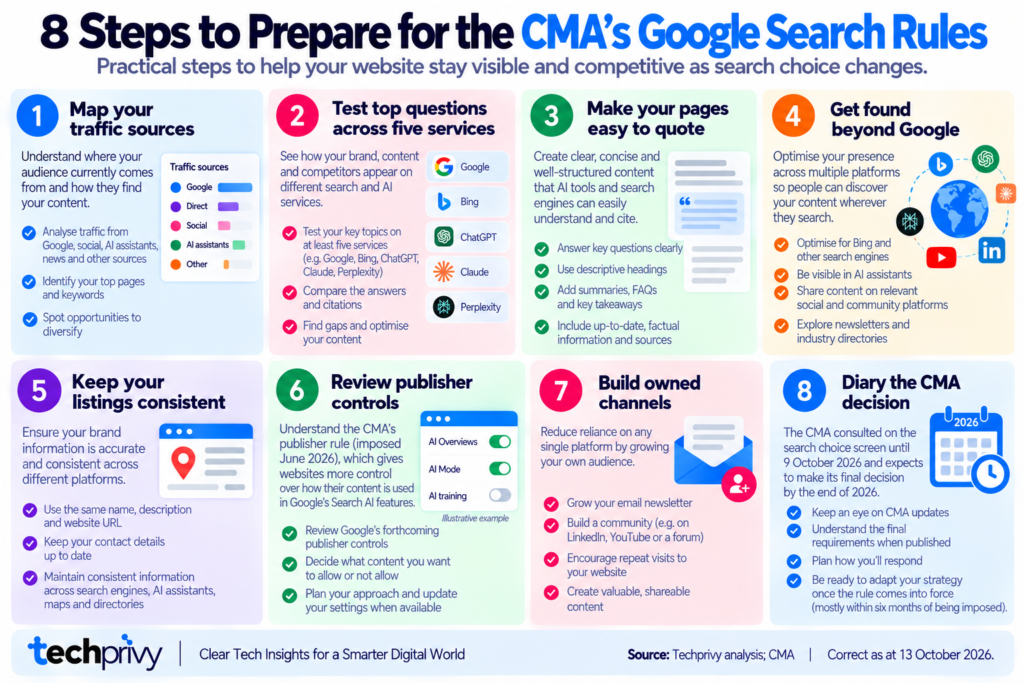
- Map where your visitors come from. Review your analytics for visits from search engines and AI assistants. Note any growth outside Google.
- Test your top customer questions. Ask them in at least five services, such as Google, Bing, ChatGPT, Claude and Perplexity. Compare who gets mentioned and cited. Our guide to keyword research and search intent helps you pick the right questions.
- Make key pages easy to quote. Give clear, direct answers near the top. Add named authors and keep facts and dates current.
- Check you can be found beyond Google. Register with Bing Webmaster Tools and confirm other search services can crawl your site. Share your content on relevant social and community platforms too.
- Keep your business listings consistent. Check your details on Google Business Profile, Bing Places and Apple Business Connect.
- Review Google’s new publisher controls as they arrive. Decide which content you want used in AI features, then weigh the visibility trade-offs. Our next article covers this in detail.
- Build channels you own. Grow your email list and your presence on LinkedIn and other platforms. Our article on networking in a tech-driven world explains why relationships matter.
- Set a reminder for the decision. Check the CMA’s case page before the end of the year and review your plan.
Be Easy to Find, Whichever Search Service Your Customers Choose
The CMA’s proposals could give UK users a regular, informed choice of search service, including AI assistants. Google will remain central to search. But visibility may now depend on several services, not one.
Businesses that are easy to find, quote and recognise will be ready, whatever the final rule says.
Book a discovery call with Techprivy to plan your visibility across search engines and AI assistants. We will show you where you appear today and what to fix first.