On 5 October 2026, OpenAI introduced a new visual ad format and wider measurement tools for ChatGPT Ads.
It is the latest step in a busy year for advertising inside ChatGPT.
OpenAI began testing ads in the US on 9 February 2026. By 11 August, it confirmed ChatGPT Ads had launched in the UK.
UK businesses can now sign up directly through OpenAI’s self-serve Ads Manager. OpenAI’s availability page lists the UK as available.
Why does this matter? OpenAI says ChatGPT reaches 1.2 billion people each week.
People use it to plan trips, choose software and furnish homes. OpenAI says ads let businesses reach people while they explore, compare and decide.
Timing matters too. Many businesses are setting Christmas budgets now. Black Friday falls on 27 November.
If you run or grow a business, you are probably asking:
- What exactly are ChatGPT Ads, and where do they appear?
- Who sees them, and what controls do users have?
- How are they different from the search ads I already run?
- What has OpenAI launched recently, and what is still in testing?
- Should my business test them before Black Friday?
This article answers each question and ends with a checklist you can work through this month.
What Are ChatGPT Ads?
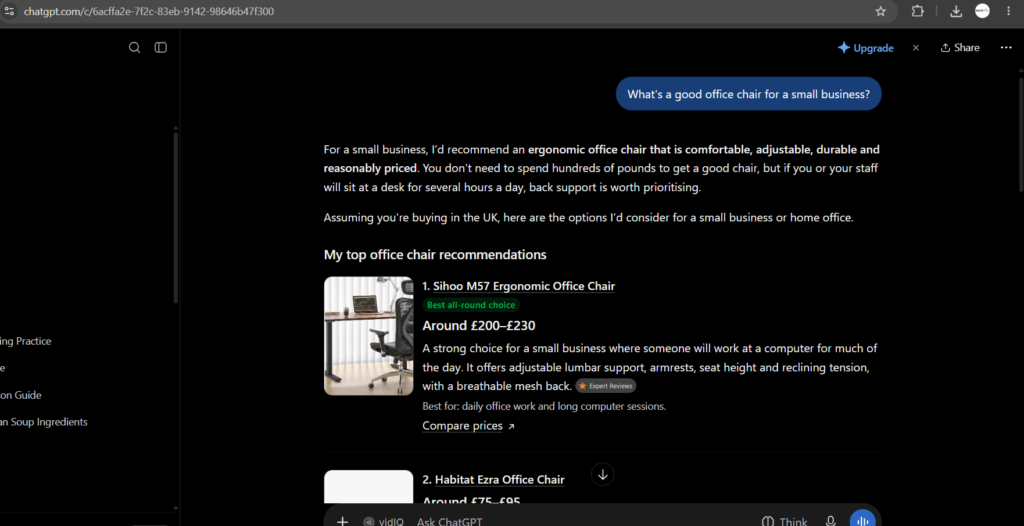
ChatGPT Ads are clearly labelled sponsored ads that appear below ChatGPT’s answers for users on the Free and Go plans.
Go is a lower-cost ChatGPT plan. Free and Go users are the only people who see ads.
According to OpenAI’s Help Center, each ad shows the advertiser’s name and logo. It also has a headline, a description, an image and a landing page link.
OpenAI states that ads do not influence the answers ChatGPT gives. Ads are labelled as sponsored and kept visually separate from the answer.
People on Plus, Pro and Business plans do not see ads. Nor do accounts identified as belonging to under-18s.
ChatGPT Ads sit beside the answer, not inside it.
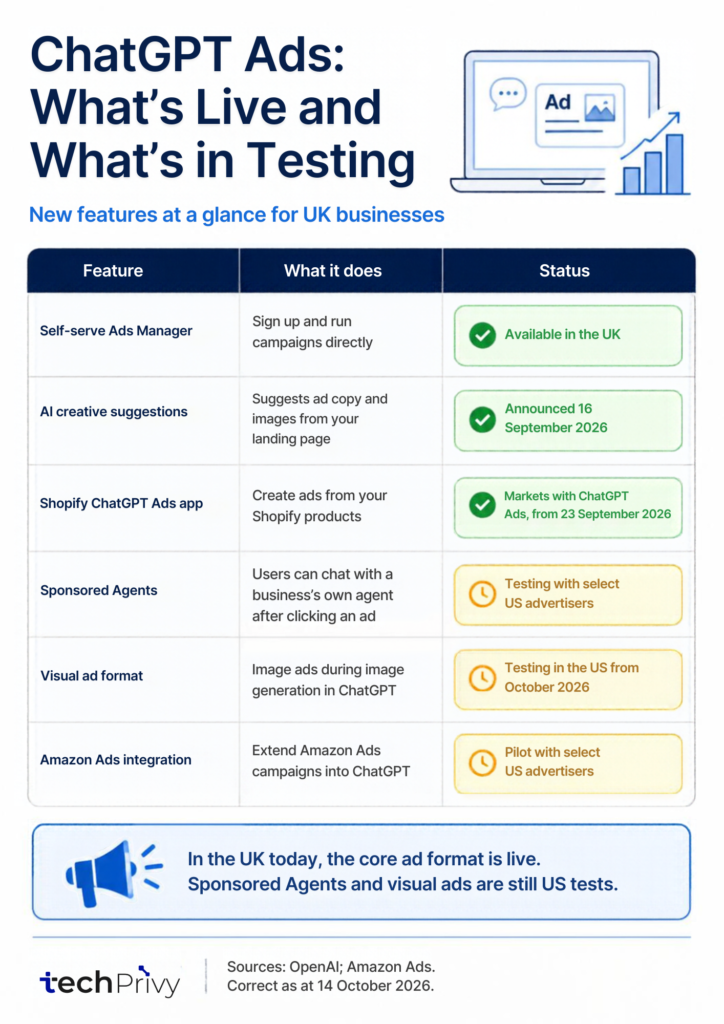
Before looking at how they work, it helps to see the key numbers.
Key Stats: ChatGPT Ads in Numbers
Every figure below comes from OpenAI’s own announcements or Help Center.
- ChatGPT reaches 2 billion people each week, OpenAI said in October 2026.
- 9 February 2026 is when OpenAI began testing ads with logged-in adult Free and Go users in the US.
- 31 European markets were added in August 2026. OpenAI called this its largest expansion to date.
- Tens of thousands of marketers had advertised on ChatGPT by August 2026, according to OpenAI.
- $3 to $5 per click is OpenAI’s recommended starting maximum bid for cost-per-click campaigns, in US dollars.
- About 15 minutes is how often impressions and clicks refresh in Ads Manager. Spend data may lag 7 to 8 hours.
- 3% lower: WeightWatchers’ attributed cost per acquisition versus its blended paid-search benchmark, per DV Rockerbox, as reported by OpenAI.
- 93% of Portland Leather’s visitors from ChatGPT Ads were new, per Triple Whale, as reported by OpenAI.
Cost per acquisition is what you pay, on average, to win one sale or lead. The last two figures are single-brand results. They are examples, not industry averages.
How Did ChatGPT Ads Get Here?
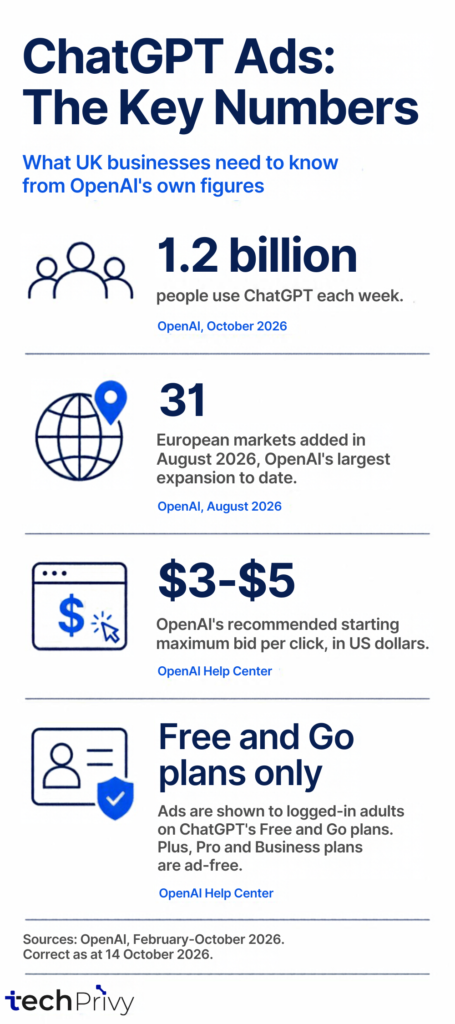
ChatGPT Ads moved from a small US test to a global platform in under a year. Here is the path, using OpenAI’s own updates.
- 9 February 2026: OpenAI started a US test for logged-in adults on Free and Go.
- 26 March 2026: OpenAI reported early results and planned pilots in Canada, Australia and New Zealand.
- 7 May 2026: OpenAI said pilots would expand to the UK, Mexico, Brazil, Japan and South Korea.
- 11 August 2026: OpenAI confirmed ChatGPT Ads had launched in those five markets, including the UK.
- 18 August 2026: OpenAI announced 31 European markets. Self-service there followed on 31 August.
- 10 September 2026: Amazon Ads announced a partnership with OpenAI. Select US advertisers are testing it.
- 16 September 2026: OpenAI announced Sponsored Agents, AI campaign tools and HubSpot and Shopify integrations.
- 5 October 2026: OpenAI added a visual ad format test and wider measurement partnerships.
Sources: OpenAI’s testing ads post and its updates, and the Europe expansion post.
ChatGPT is not the only place AI answers now carry ads. Our guide What Are AI Overviews and What Do They Mean for SEO? explains how Google’s AI answers changed search.
So how does an ad end up below a ChatGPT answer?
How Do ChatGPT Ads Work?
OpenAI’s system chooses ads based on expected relevance and outcomes. It looks at the current conversation, your landing page and your ad copy.
If a user has ad personalisation switched on, it can also use select signals from their wider ChatGPT use.
Context hints, not keyword lists
Advertisers add “context hints”. These describe the conversations, topics or keywords where their product may be relevant.
OpenAI says context hints are not exact-match keywords and do not guarantee delivery. They guide matching rather than control it.
What I am trying to say is this. You describe the conversations you want to join, rather than list exact search terms.
How you pay
You choose one of three goals in Ads Manager:
- Views: you pay per thousand impressions, known as CPM.
- Clicks: you pay for each valid click, known as CPC.
- Conversions: the system aims for a set action, such as a purchase. With click billing, you still pay per click.
Ads compete in a relevance-weighted, second-price auction. In a second-price auction, the winner’s price is set by the next-highest bid.
Relevance to the conversation shapes which ad appears, not just the size of your bid.
Who Sees ChatGPT Ads, and What Controls Do Users Have?
Ads reach logged-in adults on the Free and Go plans. OpenAI does not show ads on Plus, Pro or any Business plan.
During its test, OpenAI said ads would not appear near sensitive or regulated topics. Examples include health, mental health and politics.
OpenAI also gives users clear controls. According to OpenAI, people can:
- dismiss ads and share feedback;
- see why they are shown a particular ad;
- delete their ad data with one tap;
- manage ad personalisation at any time.
Free users can also opt out of ads in exchange for fewer daily free messages.
Privacy is built into the model. OpenAI says advertisers cannot see chats, chat history or memories. They only receive aggregate data, such as views and clicks.
I am saying this because your audience is a subset of ChatGPT users. People using ChatGPT through work Business plans will not see your ads there.
If your buyers mainly use ChatGPT through work accounts, plan for organic visibility as well as ads.
The platform has also changed quickly since September.
What Has OpenAI Launched Since September?
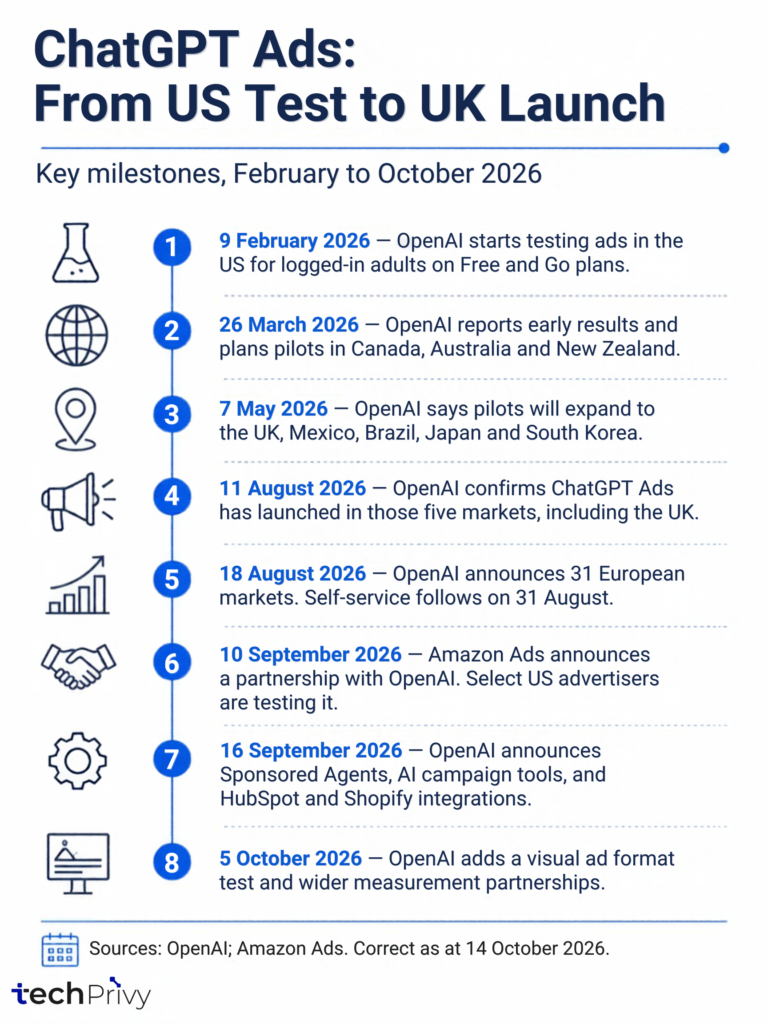
Several features are new. Some are live, and some are still in testing. Here is what each one does, from the companies’ own announcements.
AI tools for building campaigns
On 16 September, OpenAI added AI tools for advertisers. An Ads Manager plugin lets you create and analyse campaigns with plain-language prompts in ChatGPT.
Ads Manager can now suggest copy and images from your landing page. OpenAI says advertisers review and edit suggestions before adding them.
There is also an opt-in text customisation feature. It adapts your headlines to the conversation and translates copy into the user’s language.
HubSpot and Shopify integrations
HubSpot is OpenAI’s first CRM partner. CRM means customer relationship management, the system where you track leads and customers.
OpenAI says HubSpot users can create ads, track performance and follow up on leads inside HubSpot.
Shopify is OpenAI’s first ecommerce partner. OpenAI said its ChatGPT Ads app would reach markets with ChatGPT Ads from 23 September.
Sponsored Agents (US test)
Sponsored Agents let a user start a conversation with a business’s own agent after clicking its ad.
OpenAI says this conversation is clearly labelled and separate from ChatGPT’s independent answers. It is being tested with select US advertisers.
Visual ads and measurement (US test)
OpenAI is testing a visual ad format during image generation. Testing starts later in October in the US.
It also added measurement integrations with Hightouch, Tealium and LiveRamp. It is piloting brand suitability checks with DoubleVerify and Integral Ad Science.
Amazon Ads partnership (US pilot)
Amazon Ads says its partnership lets advertisers extend Amazon Ads campaigns into ChatGPT. Select US advertisers are testing it in a pilot.
|
Feature |
Status |
Source |
|
Self-serve Ads Manager |
Available in the UK |
|
|
AI creative suggestions in Ads Manager |
Announced 16 Sept 2026 |
|
|
Shopify ChatGPT Ads app |
Markets with ChatGPT Ads, from 23 Sept 2026 |
|
|
Sponsored Agents |
Testing, select US advertisers |
|
|
Visual ad format |
Testing in the US from October 2026 |
|
|
Amazon Ads integration |
Pilot, select US advertisers |
Status correct as at 14 October 2026.
How Can You Measure ChatGPT Ads?
Ads Manager reports impressions, clicks, spend, click-through rate and conversions. Click-through rate is the share of people who click after seeing your ad.
To track sales or leads, you can use the OpenAI Pixel or the Conversions API. A pixel is a small piece of code on your website.
You can also add UTM tags to your landing page links. These are short labels that show ChatGPT Ads traffic in your existing analytics.
Joined-up data makes this far easier. Our guide What Is Data Aggregation? explains why it matters.
One practical point: spend data can lag by several hours. Check results the next day, not the next hour.
With the mechanics clear, the bigger question is what this means for your growth.
What ChatGPT Ads Mean for Growing Companies and Brands
A new place to meet customers mid-decision
Many customers now ask ChatGPT for recommendations before they buy. Ads give you a way to appear at that moment.
This suits products and services people research and compare. Think furniture, software, travel, training or professional services.
A narrower audience than the headline number
ChatGPT’s weekly reach is large. But ads only reach Free and Go users who are logged in and over 18.
Some topics are also kept away from ads. Plan your expectations around that.
An early platform that is still changing
OpenAI describes Ads Manager as a beta. It says it is still early in building the full potential of ChatGPT Ads.
Features, formats and reporting will keep changing. Build in time to review your setup each month.
Your brand voice needs checking
AI suggestions and text customisation can save time. But they write copy on your behalf. Review every suggestion before it goes live.
The Techprivy view: start small and measure sales
The published results so far come from OpenAI and its measurement partners. Treat them as useful examples, not benchmarks.
Our view is that a small, time-limited test is the sensible first step. Measure sales or qualified leads, not just clicks.
Then compare your cost per sale with your existing paid search. That tells you whether ChatGPT earns a bigger budget.
A small, well-measured test beats a large, unmeasured one.
Should you test before Black Friday?
A test is likely to make sense if:
- customers research and compare before buying from you;
- you have landing pages that answer common questions clearly;
- your conversion tracking already works;
- you can fund a test without cutting channels that already sell.
It may be worth waiting if your tracking is not set up yet. The same applies if your products sit in sensitive categories, such as health.
How to Set Up a ChatGPT Ads Test This Month
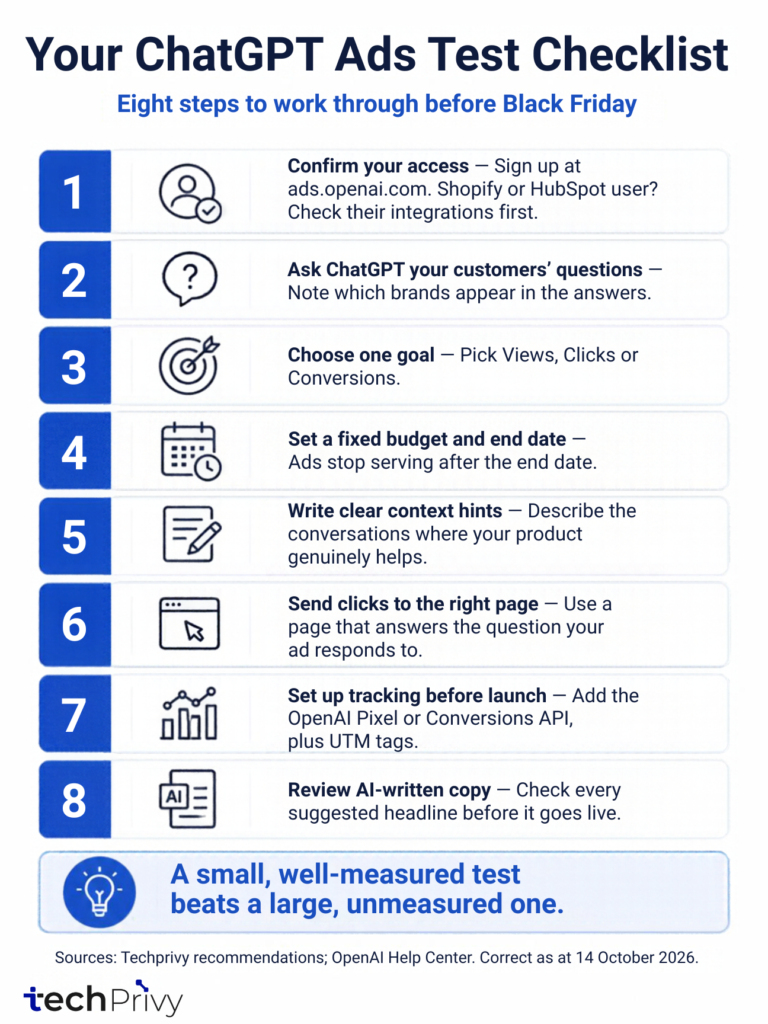
You do not need to be a marketer to follow these steps. Work through them before your Black Friday plans are fixed.
- Confirm your access. Sign up at openai.com. If you use Shopify or HubSpot, check their ChatGPT Ads integrations first.
- Ask ChatGPT your customers’ questions. Note which brands appear. Our guide to keyword research and search intent helps you pick the right questions.
- Choose one goal. Pick Views, Clicks or Conversions. One clear goal makes results easier to judge.
- Set a fixed budget and end date. Decide what you can afford to learn with. Ads stop serving after the end date.
- Write clear context hints. Describe the conversations where your product genuinely helps.
- Send clicks to the right page. Use a page that answers the question your ad responds to.
- Set up tracking before launch. Add the OpenAI Pixel or Conversions API, plus UTM tags.
- Review AI-written copy. Check every suggested headline. Decide whether to switch on text customisation.
Test ChatGPT Ads With a Clear Goal Before Black Friday
ChatGPT Ads give UK businesses a new way to reach people as they compare options. OpenAI keeps ads labelled, separate from answers and under user control.
The platform is young and changing fast. The businesses that learn most will test early, measure sales and keep their brand voice consistent.
Book a discovery call with Techprivy to plan a ChatGPT Ads test for your business. We will help you set the goal, build the tracking and read the results.