

In April 2026, Checkatrade launched an app inside ChatGPT. A homeowner explains the job in the chat, then either picks from a list of suitable local trades or, for simpler jobs, books a fixed price there and then.
Homeowners now find builders through Google Maps, directories and AI assistants. Even after a referral, many will look you up first. For a UK building firm, that means the next extension or loft conversion can go to whoever looks most credible online.
This guide explains local SEO for builders in the UK in plain English: what Google expects, what UK law says about reviews, and a simple routine that fits around site work.
You are probably asking:
- What is local SEO, and is it different for builders?
- Should I show my home or yard address on Google?
- How do I get more reviews without breaking the rules?
- Do AI assistants like ChatGPT recommend builders, and how do they choose?
- Is this worth my time, or should I get help?
In this guide:
- What is local SEO for builders?
- Key facts at a glance
- What’s changed for builders in 2026?
- How does Google decide which builders to show locally?
- How should builders set up a Google Business Profile?
- What should a builder’s website include?
- How do you get more reviews without breaking UK law?
- Which directories and trade credentials should builders use?
- How do AI assistants choose which builders to recommend?
- How do you know if local SEO is working?
- Should you do local SEO yourself or get help?
- What this means for your building business
- Your local SEO checklist for this month
- FAQ
What is local SEO for builders?
Local SEO for builders is the work of making your business show up when people nearby search for building work, in Google Search, Google Maps and AI answers.
SEO (search engine optimisation) means helping search engines understand what you do and where. “Local” means the search has a place in it, such as “builder in Leicester” or “loft conversion near me”.
There are three places a builder can appear:
- The local pack (or map pack): a small group of businesses shown with a map, often above normal results. It comes from Google Business Profiles.
- Normal (organic) results: the list of web pages below, including your website and directory listings.
- AI answers: written summaries from Google’s AI Overviews, Google’s AI Mode and tools like ChatGPT, which often name businesses and their sources.
Why builders are different from emergency trades
Building work is rarely an emergency. Someone with a burst pipe wants the nearest available plumber. Someone planning an extension or loft conversion is making a large, planned spend, often with planning permission questions, so they compare builders carefully. Proof of past work, reviews and clear answers count for more than speed.
Key facts at a glance
These are the facts this guide relies on. Each comes from the organisation itself or the original research, checked on 18 October 2026.
| Fact | Detail | Source |
|---|---|---|
| How Google ranks local results | Mainly on relevance, distance and prominence. Google says local rankings can’t be bought or requested. | Google Business Profile Help |
| Service areas | Up to 20 service areas, with Google recommending your overall area stays within about 2 hours’ drive of your base | Google Business Profile Help |
| UK fake reviews ban | The consumer law parts of the Digital Markets, Competition and Consumers Act 2024 came into force on 6 April 2025, including a ban on fake reviews | CMA, Fake reviews guidance (CMA208) |
| AI answers and directories | Checkatrade was the source behind 50 of 60 Google AI Mode answers for electricians, plumbers and roofers across 20 UK towns, collected on 22 August 2026. One run per question, no retries: an indicator only. | Whito, AI recommendation research |
What’s changed for builders in 2026?
Homeowners can now ask AI tools to find a builder, and UK review rules are being enforced.
AI answers inside Google. AI Overviews are the AI-written summaries at the top of some Google results. AI Mode is a separate part of Google Search where people ask longer questions and follow-ups, like a chat. Google started rolling it out in the UK on 28 July 2025, as a tab on the results page and in the Google app. Our guide to What Are AI Overviews and What Do They Mean for SEO? explains more.
Review rules are being enforced. The CMA (Competition and Markets Authority), the UK’s consumer law regulator, announced five new investigations into fake and misleading reviews on 27 March 2026. They cover firms in car sales, food delivery and funerals, plus a company that runs review services. None involve builders, and the CMA says it hasn’t reached any view on whether the law was broken. But the rules are now being applied.
How does Google decide which builders to show locally?
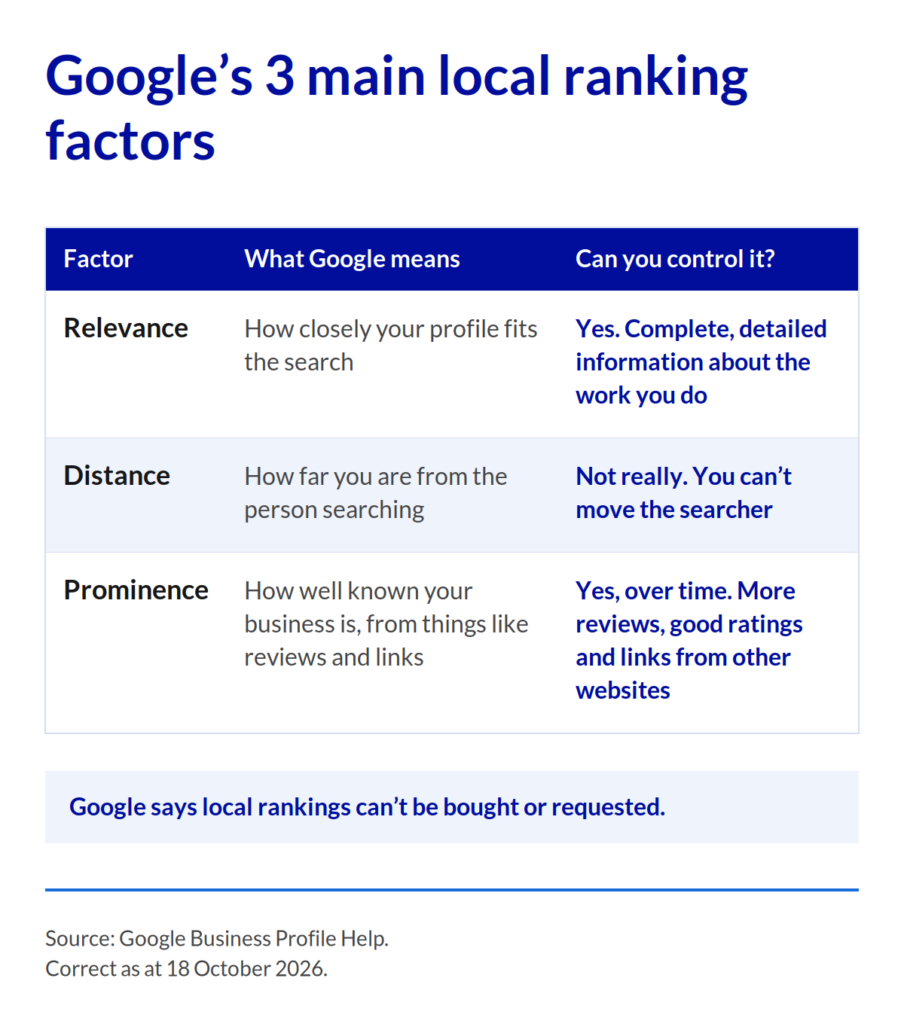
Google says local results are based mainly on three things: relevance, distance and prominence. It also says local rankings can’t be bought or requested. You may see sponsored listings in Maps, but those are labelled ads, separate from the local ranking.
| Factor | What Google means | Can you control it? |
|---|---|---|
| Relevance | How closely your profile fits the search | Yes. Complete, detailed information about the work you do |
| Distance | How far you are from the person searching. If they don’t share a location, Google uses what it knows | Not really. You can’t move the searcher |
| Prominence | How well known your business is, based on information from across the web (such as links, articles and directories) and your Google review count and rating | Yes, over time. More reviews, good ratings and links from other websites |
Google says more reviews and positive ratings can help. So spend your time on relevance and prominence, and don’t worry about distance.
How should builders set up a Google Business Profile?
Set it up as a service-area business: hide your address if customers don’t visit, list the areas you cover and keep one profile only. A Google Business Profile is the free listing that puts you on Google Maps and in the local pack.
Should you show your home or yard address?
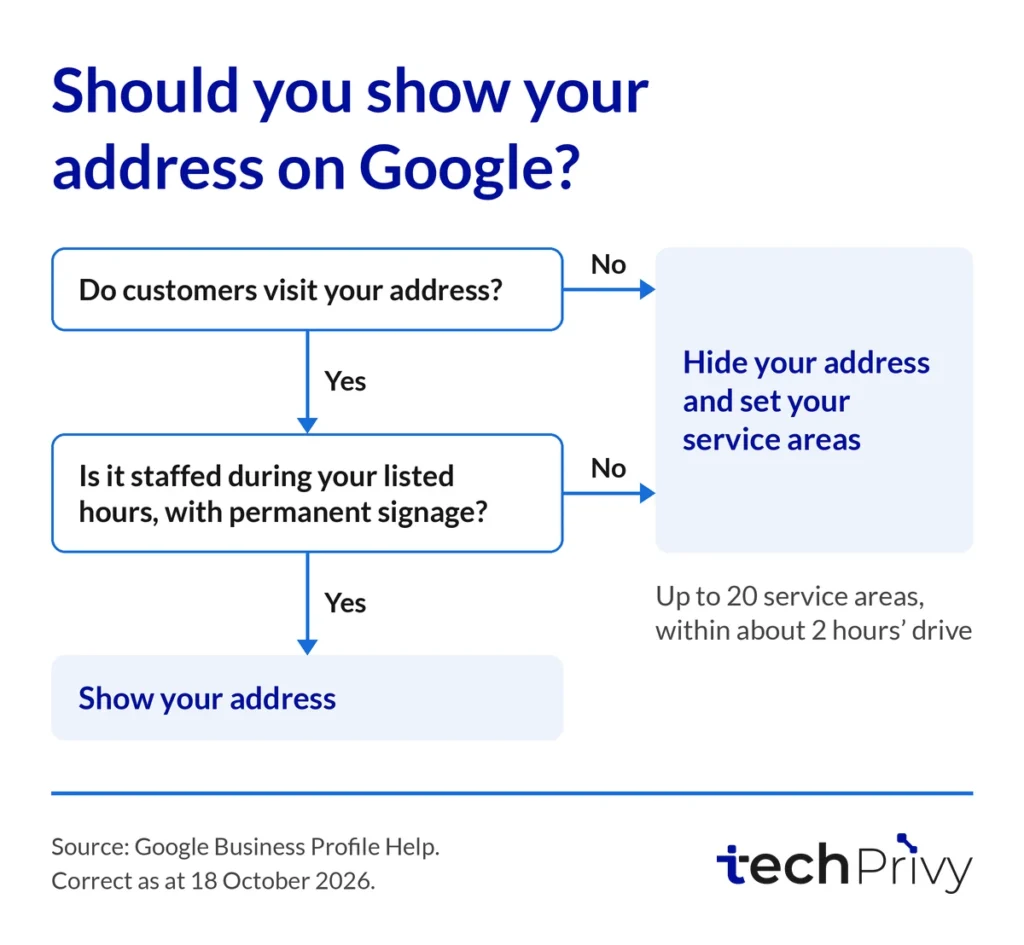
No, not if customers don’t come to you. In that case, Google’s guidelines say you should hide your address, and your public profile shows the areas you cover instead. Only show an address if customers visit it, it’s staffed during your listed hours and it has permanent signage.
How many areas can you cover?
Up to 20, such as towns or postcodes, with Google recommending your overall area stays within about 2 hours’ drive of your base. Twenty is a limit, not a target.
Why one profile only?
Google allows a business that travels to customers one service-area profile, and says it may suspend profiles that break its guidelines. So no second profile “for the next town”.
Then pick the category that best fits your main work, list each service, add recent job photos (with the customer’s permission) and copy your review link to send to customers.
What should a builder’s website include?
A page for each type of job you do, proof of finished work and honest answers to the questions homeowners ask before they hire.
A page for each type of job
Give extensions, loft conversions, renovations or whatever you do most a page each. Answer real questions: what affects the price, how long the work usually takes and when planning permission may come into it.
Our founder, Adeoluwa, saw this first-hand before Techprivy, writing SEO-focused content for MyConstructor, whose audience was tradespeople and sole traders such as builders, carpenters and electricians:
“I researched the questions builders and sole traders were searching for. Many searches went beyond finding a tradesperson or getting a quote. People wanted to understand costs, compare options, avoid common mistakes and know what to expect before committing. It taught me to build content around real customer questions, not just promote services.”
Start with the questions customers ask you on quote visits. Our guide on Why Is Keyword Research an Important Factor in SEO explains how to check what people search for.
Project pages that prove your work
A project page is a short write-up of one finished job: before and after photos, what the job involved and the town, mentioned naturally. Get the customer’s written permission first, and never show a house number.
How do you cover nearby towns without thin pages?
Use real project pages, not copy-and-paste town pages. Google’s spam policies warn against “doorway abuse”: lots of near-identical town pages that all lead to the same place. One page about a real loft conversion in a town beats ten pages with only the town name changed.
How do you get more reviews without breaking UK law?
Ask every customer for an honest review, never write or buy fake ones, and never hide bad ones. That keeps you inside UK consumer law and Google’s own rules.
How to ask. Send your Google review link at handover or soon after, to every customer, not just the ones you expect to be pleased. Reply to every review, good or bad, calmly.
What the law bans. The Digital Markets, Competition and Consumers Act 2024 (DMCC Act) updated UK consumer law. The CMA’s guidance on it, CMA208, explains that it bans:
- fake reviews, positive or negative, whether you write them or pay someone else to;
- reviews that hide the fact they were given in return for something;
- showing reviews in a misleading way, such as hiding negative ones or cherry-picking good ones.
What Google adds. Google doesn’t allow payment, discounts or free work in exchange for reviews, or asking only happy customers. So don’t offer anything for a review on Google.
This is a plain-English summary, not legal advice. If in doubt, read the CMA guidance or ask a solicitor.
Which directories and trade credentials should builders use?
Use a few trusted directories and trade bodies that fit your work, keep your details identical everywhere, and only show memberships you actually hold. Homeowners use these listings to check you, and AI assistants can cite them.
- FMB (Federation of Master Builders): a trade association for building firms, with a member directory.
- TrustMark: a Government Endorsed Quality Scheme for work in and around the home.
- Checkatrade and similar directories: sites where homeowners find tradespeople and read reviews.
Use the same business name, service area, phone number and website on every listing. Choose directories by where your customers look, not because you feel you must pay for them. And never show a logo or accreditation you don’t hold: it could mislead customers.
How do AI assistants choose which builders to recommend?
Nobody outside the AI companies knows exactly, and no one can guarantee a mention. But AI answers about local trades often lean on sources they can check, such as directories, review sites and business profiles.
In Whito’s August 2026 snapshot, Checkatrade was the source behind 50 of 60 Google AI Mode answers for other trades. It was a single run and didn’t cover builders, so treat it as an indicator only. The lesson: make every source an AI tool might read about you accurate and consistent.
A 20-minute check of what AI assistants say about you
- Open the tools. ChatGPT and the AI Mode tab in Google Search, ideally in a private browser window.
- Ask like a homeowner. “A trusted builder in [your town]”, then “a builder for a loft conversion in [your town]”.
- Note the sources. Which businesses are named, and which websites, directories or review sites each answer mentions.
- Check yourself. Are you named, and are your details right?
- Fix those sources first. Your profile, directory listings and reviews. Then repeat the check in a month.
Adeoluwa tried this for Derby:
“I searched ‘a trusted builder in Derby’ in ChatGPT and Google AI Mode, recorded the sources each one cited and compared the overlap. What made those sources useful was customer reviews, trade membership and local business information. It reinforced how much credible, consistent information across your website and trusted directories matters.”
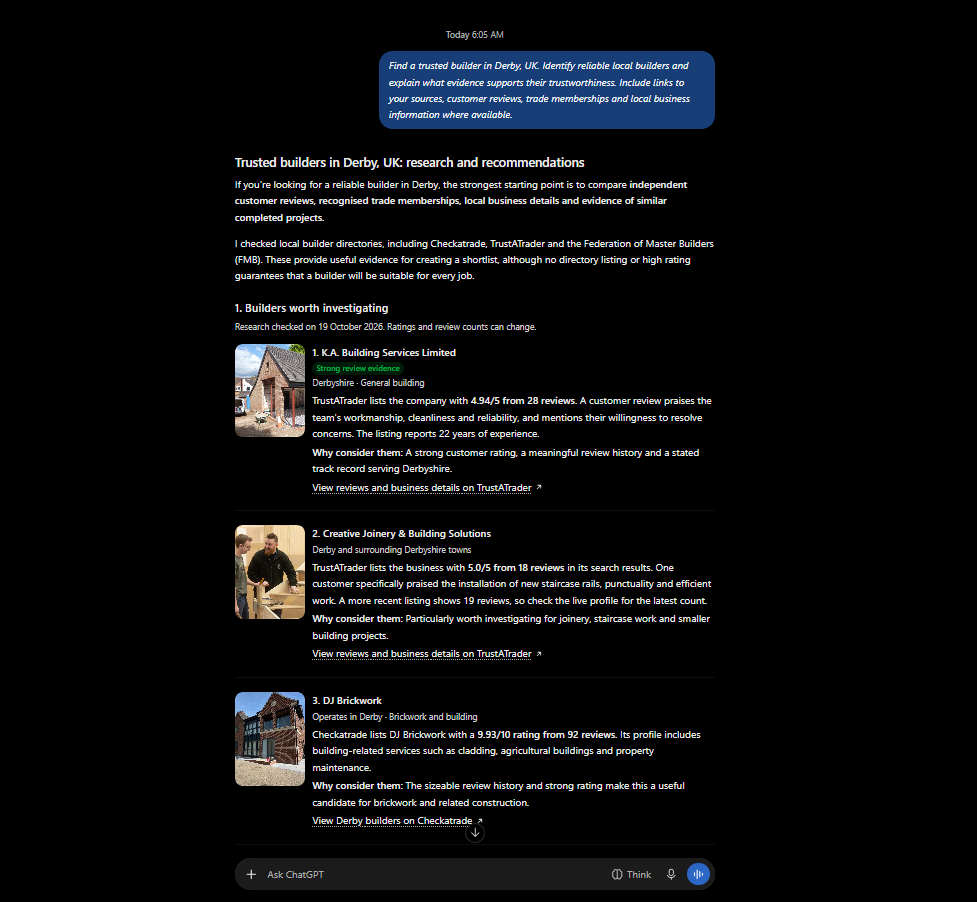
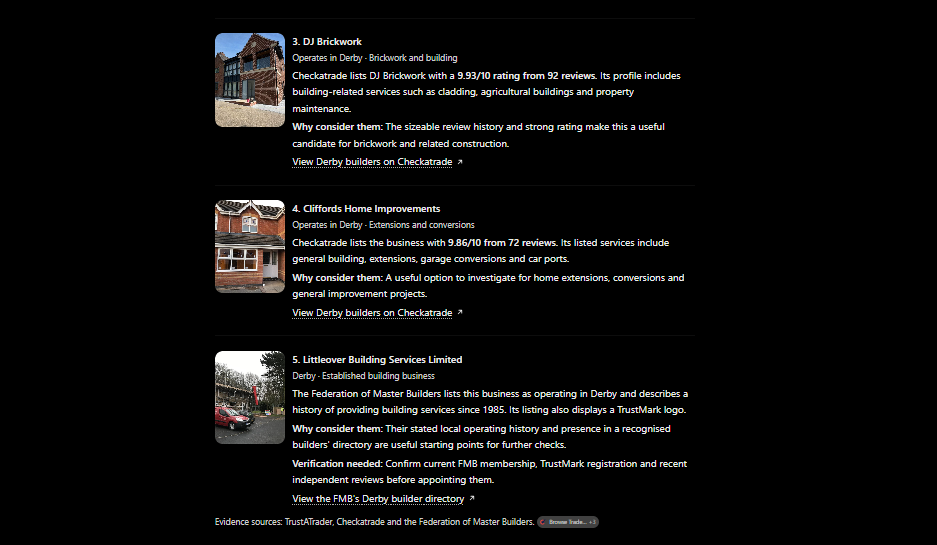
Source: Screenshot on ChatGPT
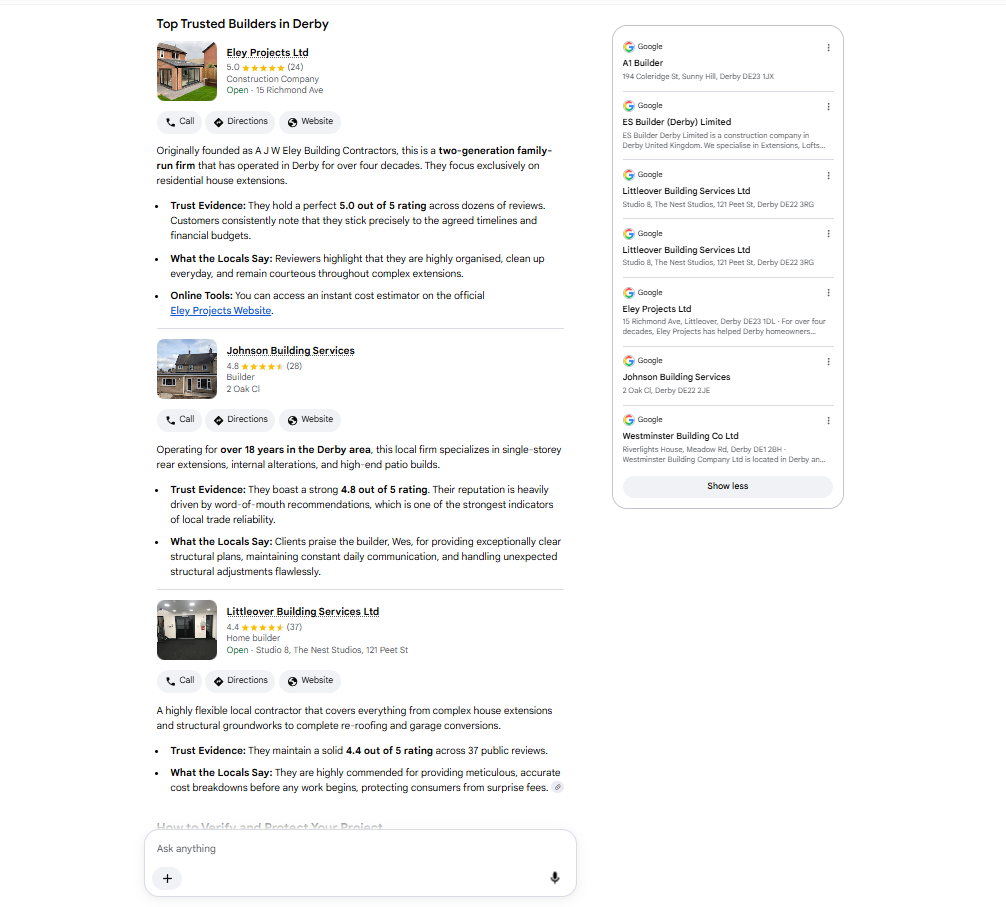
Source: Screenshot on Google AI mode
How do you know if local SEO is working?
Measure enquiries and won jobs, not rankings. The question is whether more of the right people get in touch, and whether they turn into work.
- Google Business Profile performance shows actions such as calls, website clicks and direction requests, where they apply to your business. The figures include visits from Google Ads, not just unpaid ones.
- Google Search Console is a tool from Google showing which searches your website appears for and how many people click.
Then keep a simple spreadsheet: enquiry source, date, quoted, won and job value. Rankings alone mislead, because results change with where the searcher is. How long it takes depends on your competition, area and starting point; anyone promising a fixed timeline is guessing.
Should you do local SEO yourself or get help?
Many small builders can handle the basics in a few hours a month. Help makes more sense when you have no time, each job is worth a lot, or your area is crowded with competitors.
With only two hours a month, Adeoluwa’s advice is to spend most of it on your Google Business Profile (services, location, contact details and recent project photos), then answer one question customers actually ask, on your website or social media.
I’d prioritise being easy to find and building trust over trying to post content everywhere. Adeoluwa, founder, Techprivy
If you bring someone in, ask:
- Who will own my profile and accounts? You should.
- What will you report on? Enquiries and won work, not just rankings.
- Do you guarantee rankings? Google says local rankings can’t be bought or requested, so a guarantee is a warning sign.
What this means for your building business
You don’t need a big budget to show up locally: just the basics done properly, then a habit that adds fresh proof of your work. After each finished job:
- Add photos to your Google Business Profile, with the customer’s permission.
- Write a short project page on your website: the job, the town and what made it tricky.
- Send your review link at handover.
This builds relevance and prominence, the two factors you can influence, without a separate marketing day. It’s the kind of repeatable system we build into our services.
Your local SEO checklist for this month
- Check your profile is set up as a service-area business, with your address hidden if customers don’t visit, and only real places in your service areas.
- Search Google and Maps for any duplicate profiles of your business, and deal with them.
- Add photos from your last three jobs, with your customers’ permission.
- Write one project page on your website about a recent job.
- Send your review link to your last five customers, all of them, not just the happiest.
- Check your business name, service area, phone number and website match on every directory listing.
- Run the 20-minute AI check and note which sources come up.
- Start a simple spreadsheet to track where enquiries come from and which turn into jobs.
FAQ
How do builders get on Google Maps?
Create a free Google Business Profile, choose service-area business if customers don’t visit you, add the areas you cover and verify it with Google. Once verified, your profile can appear on Google Maps and in the local pack. Fill in your services, photos and review link so it has the best chance of matching local searches.
Should I put my home address on Google?
Not if customers don’t visit you there. In that case, Google’s guidelines say you should hide your address, and your public profile shows the towns or postcodes you cover instead. You can add up to 20 service areas. Only show an address if customers visit it, it’s staffed during your hours and it has permanent signage.
Do Checkatrade reviews help my Google ranking?
Google hasn’t said that reviews on directories such as Checkatrade directly affect your Google ranking. It says prominence draws on information from across the web, including directories, plus your Google review count and rating. Directory reviews can still help homeowners trust you, and AI assistants sometimes draw on directories when they answer.
How long does local SEO take for a builder?
There’s no fixed timeline. It depends on how many builders compete in your area, how large your service area is and where you’re starting from. Fixing your profile can be quick, but building reviews, project pages and a trusted reputation takes steady, ongoing work. Be wary of anyone promising results by a set date.
How much does local SEO cost?
It depends on what you need. The main factors are how competitive your area is, how much work your profile and website need, how many service and project pages you want, and whether you need one-off setup or ongoing help. Much of the basic work, like updating your profile, costs nothing but your time.
Is local SEO worth it for a small builder?
It’s often worth it if you want to rely less on referrals or paid leads, or if you take on high-value jobs where one extra project matters. It’s less urgent if you’re fully booked for months and have no capacity. Even then, keeping your profile accurate is worth a few minutes.
Start With Your Profile, Then Let Every Job Do the Work
Good local SEO for builders in the UK follows a clear order. Get your Google Business Profile right first, then add a useful page for each type of job, collect honest reviews and keep your directory details consistent. After that, let every finished job add photos, a project page and a review.
If you’d like help working out which of these to fix first, book a discovery call and we’ll look at where your business shows up now.

2 Comments
Pingback: What Are AI Overviews and What Do They Mean for SEO? - Techprivy
Pingback: The Importance of Keyword Research for SEO: Tips and Tools